Wednesday, October 1, 2014

Orange Park: The First Coast's Overlooked Historic City

Published August 20, 2014 in History
When one hears the name "Orange Park," congested Blanding Boulevard and post-WWII suburbia immediately enters the mind of many. However, a short trip off the beaten path of gridlocked arterials, Blanding and Park Avenue, reveals a scenic and peaceful community that dates back to the late 19th century.


River Road

18.


19.


20.


21.


22.


23.


24.


25.


26.


27.


28.


29.


30.


31.


32.


33.


34.

Moosehaven - City of Contentment

35.


37.

Kingsley Avenue east of Park Avenue is a throw back to a quiet northern Clay County.

Article by Ennis Davis, AICP. Contact Ennis at edavis@metrojacksonville.com

Orange Park: The First Coast's Overlooked Historic City

Published August 20, 2014 in History
When one hears the name "Orange Park," congested Blanding Boulevard and post-WWII suburbia immediately enters the mind of many. However, a short trip off the beaten path of gridlocked arterials, Blanding and Park Avenue, reveals a scenic and peaceful community that dates back to the late 19th century.


Orange Park 2014

1.

Kingsley Avenue is one of a few FDOT streets in Northeast Florida to have buffered bike lanes.

2.

727 Kingsley Avenue was once the Atlantic Coast Line Railroad's Orange Park depot. Located 14 miles from downtown Jacksonville, Orange Park was a stop for the many passenger trains that plied the rails from New York to Tampa/St. Petersburg, FL. The station remained active until the sixties and passenger service went from a regular stop to a flag stop.

3.


4.

First Coast Rail's PV "Georgia 300". The property is now leased and maintained by G&LM;.

5.


6.


7.


8.

Orange Park Medical Center

9.


10.


11.

Doctors Lake Drive

12.


13.

Best Bet - Orange Park Kennel Club


Club Continental

14.


15.


16.


17.


Orange Park: The First Coast's Overlooked Historic City

Published August 20, 2014 in History
When one hears the name "Orange Park," congested Blanding Boulevard and post-WWII suburbia immediately enters the mind of many. However, a short trip off the beaten path of gridlocked arterials, Blanding and Park Avenue, reveals a scenic and peaceful community that dates back to the late 19th century.


The largest Sign in America, at 200' long x 15' high, during 1890s. Courtesy of the State Archives of Florida, Florida Memory,http://floridamemory.com/items/show/6506

In 1877, the Florida Winter Home and Improvement Company acquired the "McIntosh" plantation at Laurel Grove, which had fallen on hard times after the Civil War. The name "Laurel Grove" was that of a plantation once owned by Zephaniah Kingsley, who developed it into a "model farming operation" after acquiring it from Sarah and William Pengree in 1803. In 1813, it was burned to the ground by Anna Madgigine Jai Kingsley, wife of Zephaniah, to keep it out of the hands of patriots seeking to bring Spanish Florida under the control of a young United States.

Kingsley Avenue during the 1880s. The road was named for planter Zephaniah Kingsley, who owned large amount of property in Orange Park in the early 1800s. Courtesy of the State Archives of Florida, Florida Memory, http://floridamemory.com/items/show/6503

Soon, the Florida Winter Home and Improvement Company, whose owners and trustees were predominatly from Boston, subdivided the former plantation into a new farming town called Orange Park. To enhance buyers, many lots were planted with Orange trees. To attract tourists, the Hotel Marion was constructed at the foot of Kingsley Avenue, featuring a 1,200' pier into the St. Johns River.

In 1922, Hotel Marion was acquired by Moosehart. Illinois-based Moosehart, "the Child City," dedicated it as a home for aging Moose members known as "Moosehaven." The original concept of Moosehaven was to "organize residents so that they might hlp each other and help themselves, and provide from their own energy the major part of the cost of their keep."  During the course of the 20th century, Moosehaven's 72-acre campus has evolved from a working farm and dairy to a Continuing Care Retirement Community, exclusively for members of The Loyal Order of Moose and Women of the Moose.

Residents of Moosehaven retirement community on July 2, 1961. Moosehaven, "City of Contentment," was a retirement community created and operated by the Loyal Order of Moose, a fraternal society created in 1888 in Indiana. It was located at 1700 River Road in Orange Park. In 1922, the order purchased 22 acres to create an elderly home for its retired members (many of which were living at Mooseheart Children's Home in Chicago). That fall, its first 20 residents arrived. It later was expanded to 63 acres and over 400 residents.

In 1923, a year after the Hotel Marion was sold, Caleb Johnson, heir to the Palmolive Soap Company, completed his winter palazzo, Mira Rio. The Wisconsin-based family found their way to Orange Park as a result of B.J. Johnson, founder of the Palmolive Soap Company, looking for a place to escape harsh winters during the late 1800s. In 1966, Jon Massee, Caleb Johnson's grandson, converted the waterfront residence into a private club. Today, the 700 member Club Continental is managed by Jon's daughter, Karrie Massee. Palmolive Soap is now known as the billion-dollar Colgate-Palmolive Company.

Caleb Johnson's Mira Rio. Image courtesy of http://clubcontinental.com/the-club/history/

Prior to 1970, to cross the river to Mandarin required a drive north to downtown Jacksonville or south to Green Cove Springs. Total roundtrip for the downtown route averaged one hour, while the Green Cove Springs route was a little longer.  This mobility problem was resolved with the opening of the 3.1-mile Buckman Bridge on May 1, 1970.  Also known as I-295 West Beltway, the bridge was named after Henry Holland Buckman, a prominent 19th century Duval County attorney legislator who was instrumental in establishing the Florida state road system. Buckman was also the author of the Buckman Act, a 1905 law that reorganized higher education in Florida into three institutions based on race and gender: Florida Agricultural and Mechanical University for African Americans, Florida State University for Caucasian women, and University of Florida for Caucasian men.

After the opening of the Buckman Bridge in 1970 and the Orange Park Mall in 1975, rural lands on the outskirts of Orange Park gave way to suburban sprawl fueled by former Duval County residents seeking better schools and a change of pace from the urban center to the north. Now a bedroom community to Jacksonville, Orange Park isn't known as a major employment, logistics, or industrial center. However, it is home to an interesting rail-based outfit called First Coast Rail, Inc.  First Coast Rail, Inc. is a small company that makes passenger car repairs just off Kingsley Avenue. First Coast Rail's Georgia 300 carried President Barack Obama and his family to the President's inauguration in Washington, DC in 2009. The Pullman Company built the Georgia 300 in 1930 as the 10-section lounge General Polk. In 1954, it was converted into a business car by the Georgia Railroad.


Blanding Boulevard through a rear view mirror.

Despite massive gridlock centered around its two main thoroughfares, the actual Town of Orange Park is much smaller than most imagine.  According to the 2010 Census, the incorporated city is 3.6 square miles with a population of 8,412. For anyone looking to get a feel of the old community, the River Road Historic District is a great place to start. Designated as a U.S. historic district on July 15, 1998, it is situated around the junction of River Road and Stiles Avenue, overlooking the St. Johns River.


Early Orange Park

Ulysses S. Grant visiting Orange Park in January, 1880. Courtesy of the State Archives of Florida, Florida Memory,http://floridamemory.com/items/show/153265


An Orange Park street scene in 1929. Included in the picture are George Shumeyer, George Austead, (?) Elmore. Courtesy of the State Archives of Florida, Florida Memory, http://floridamemory.com/items/show/6504


F.W. Truex and his horse, Red Eagle. Courtesy of the State Archives of Florida, Florida Memory, http://floridamemory.com/items/show/66909


1884 map of Orange Park and Ridgewood
http://www.metrojacksonville.com/mobile/article/2014-aug-orange-park-the-first-coasts-overlooked-historic-city/page/1

Friday, December 27, 2013

Robert C. Broward

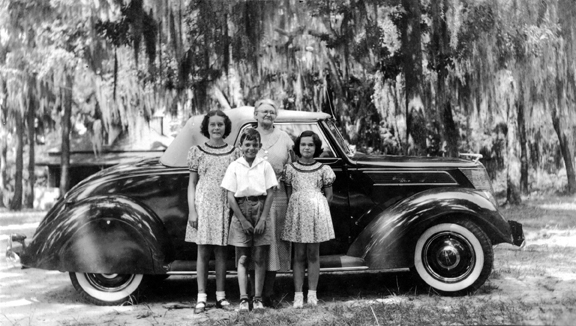
Bob around age nine in White Springs, with another family showing off their new Ford Coupe’
By Victoria Register-Freeman
Author and award winning architect Robert C. “Bob” Broward stood recently in his former San Marco office and greeted family, friends, former colleagues and admirers. The office, repurposed by his daughter Kristanna Broward Barnes and architect Catherine Duncan, is now available for rent as creative space to architects, engineers, contractors, graphic designers, and other folks who want to be in an exciting studio environment. Forty-eight years of good karma is listed on the rental brochure as one of the office’s many attributes.
If, as the dictionary says, positive actions produce good karma, Bob Broward provided such actions. A father of two and grandfather of five, he has a recognized legacy of architectural excellence, having received over 40 merit and honor awards including three “Test of Time” awards. In 2011 he was selected as a Fellow of the American Institute of Architecture, his profession’s highest award. In early 2012, he was inducted into the Florida Artists’ Hall of Fame.
He has been a mentor to many aspiring architects, an Adjunct Professor of Design at the University of Florida, and an advocate for historic preservation. His work exhibited a reverence for nature long before that stance was a popular one. As he is fond of saying, “Everything is a habitat for some living creature.”
Asked to identify the source of his reverence, Broward points to two factors. “First, my family home was on River Road in San Marco, but that road was an unpaved stretch of dirt when I was a boy. It led to the swamp which is now a park. I was the youngest of six children in my family, youngest by nine years, and there were no neighbors until the mid-30s. Even though I was not allowed the swamp, its mystery and lure were irresistible. With Craig’s creek running through it, it became my personal playground. During the day I could see the critters. At night, I could hear alligators bellow and occasionally a panther scream. It was a time before television when we created our own images.
“Second, after a tour flying B-17’s with the Air Force, I enrolled at Georgia Tech to study architecture. I had always loved to draw and remember selling my original drawings of houses with wide eaves to my mother for two cents. I think I charged other folks five cents.  At Tech I was reading a copy of Architectural Forum and saw the work of Frank Lloyd Wright. I knew that was the kind of architecture I wanted to create. His buildings were a part of the environment rather than an intrusion.”
Broward went to Lakeland, where Wright was building Florida Southern College and found a job laboring on the site. As a result of that contact, Wright awarded Broward fellowships to study at both of his compounds, Taliesin East, in Wisconsin, and Taliesin West, in Scottsdale, Arizona. Broward grins when he relates how he inadvertently tipped “the master’s” bulldozer over in a bold but failed attempt to impress Wright.
Honoring Wright’s legacy, Broward’s buildings use open space, natural forms and natural materials to embrace the environment. An excellent example of his style is the Unitarian Universalist Church in Arlington.
“I went out and spent the night on that site before I began to work on the project,” Broward recalls. “It faces a pool of water that reflects the building and curving members of the structure attach it to the land. There is also a nature walk designed as a memorial to one of the church members. I had survived a serious car wreck before I began work on the church and I felt that I had been given a second gift of life which allowed me to express gratitude by giving back. I put so much into that building. Every little detail came out of my heart.”
Another detail of the Unitarian Church was the inclusion of a wall hanging by Jacksonville fiber artist, Memphis Wood. Broward frequently commissioned the work of other artists for his projects. “Memphis Wood was a teacher of mine at Landon when I was in high school. She was a young red-head and quite a lady. Another teacher I remember fondly is Harold Bess, my drafting teacher.”
Broward’s connection with water has informed his architecture. One warehouse he designed has a roof that collects water and shoots it forward in an aesthetic spray. “High winds and heavy rains are normal for us. I would like to see architecture in Jacksonville relate more to the city’s location. We’re on the river, a big water park. It’s such a magnificent river and it‘s not respected enough. ”
At the other end of the architectural style spectrum, Broward has worked to preserve numerous historic structures. Having authored a book in 1983 on Henry John Klutho’s influence on Jacksonville’s architecture, Broward was a consultant for the restoration of Klutho’s St. James Building when it was turned into Jacksonville’s new City Hall in the mid-‘90s. Broward also restored the interior of the marble bank that is now in disrepair. He tried three times to help restore the Downtown Laura Street Trio, a group of structures that has been cited as crucial for Jacksonville’s historic urban identity.
Broward’s stories of early Jacksonville capture a city that is unknown in historic photographs. “My father, who held the record for river crossings, ran the St. Johns River ferry that provided access to both banks of the river. He went to work at 3 a.m. and finished at 3 p.m. seven days a week. If something happened and he had to call in a substitute there was only one, Mr. Westcott, a Dutchman who lived in a boat house off the Southside docks where Prudential is now. I remember walking those docks and seeing lots of people living there. It was the Depression and folks were poor, really poor. I have never seen a picture of the boat houses, as they were called.”
Asked what advice he would give aspiring architects, Broward pauses for a moment and looks out his living room window at the panoramic river view he and wife Myrtice Craig enjoy from their home. It is evident that this is a question he has been asked many times, one that he takes seriously from a legacy perspective. “I would tell them to be prepared to devote their life to their craft. Architecture is not a business; it is an art. You must never be half-hearted in its practice.”